People

Monday, September 26, 2016

KAMPUNI YA TANZ GRAPHITE WATOA MSAADA WA TAULO ZA KIKE (SODO) KWA WASICHANA WA SHULE YA SEKONDARI SELINA KOMBANI ILIYOPO WILAYANI MAHENGE

Kampuni ya Tanz Graphite (Tz) Limited imetoa msaada wa taulo za kike kupitia kampeni yake ya Keep a Girl in School (Muweke msichana shuleni) ambapo zaidi ya watoto wa kike 200 wamefaidika kwa kupata sodo za kutumia mwaka mzima wa masomo wawapo shuleni.
Hii inatokana na changamoto kubwa inayowakumba watoto wa kike wawapo shuleni na kwa kiasi kikubwa cha watoto wa kike huwa wanakosa uwezo wa kusoma vyema na kuhudhuria masomo yao wawapo shuleni na kuwapelekea kukosa vipindi. Kwa kupatiwa msaada huu watoto wa kike wanakuwa huru na uwezo mkubwa wa kuhudhuria darasani.
Katika kampeni hii mtoto wa kike anajengewa uwezo wa kujiamini na kujitambua na pia kuweza kujiendeleza kimaisha kwa kujengewa uwezo wa kupambana na changamoto zinazomkabili na kuweza kuzitatua pasipo woga wowote. Pia wanafunzi walifundishwa kuhusu usafi na matumizi bora ya sodo zenye kufaa wakati na baada ya hedhi.
Katika tukio hili wanafunzi walifundishwa darasani ikiwemo elimu ya idhaa ya ndoto, Dhana Binafsi na muongozo wa kazi.

Mkufunzi wa Muweke Msichana Shuleni Ms. Camila Roshi akitoa somo kwa watoto wa shule ya sekondari ambapo darasa hili watoto wa kike na wa kiume walijifunza elimu mbalimbali ikiwemo Idhaa ya ndoto, dhana binafsi na muongozo wa kazi. Aliyesimama wa pili kushoto ni mkuu wa shule ya Selina Kombani (Picha na Madam Neema)

Wanafunzi wa Shule ya sekondari ya Selina Kombani wakipatiwa msaada wa sodo. Zaidi ya watoto 200 walipatiwa sodo za kuwatosha kwa matumizi ya mwaka mzima hasa wawapo shueni (Picha na Ms. Camila Roshi)


Wanafunzi wakifurahi kwa kucheza ngoma za asili kwa kupatiwa msaada wa sodo kwa zaidi ya wanafunzi 200 wa kike. (Picha na Camila Roshi)

Monday, May 16, 2016

Why college students keep getting the mumps — even though they’ve been vaccinated

College students are coming down with an illness most people think hasn't been a problem in the US for years: the mumps.
Three students at Butler University, two at Indiana University, and two at Kansas State University have been diagnosed with the mumps in the past few weeks. Most had been fully vaccinated against the disease, according to their universities.
Mumps cases in the US dropped dramatically after vaccination for the disease began in 1977. But the disease has been making a comeback in the past 10 years, ever since a historic 2006 outbreak mostly among students at Midwestern colleges:
I spoke with Dr. William Schaffner, an infectious disease specialist at Vanderbilt University, about why the mumps vaccine doesn't work so well, why new mumps cases are probably being imported from Europe, and what can be done to stop this.
Libby Nelson: Most, if not all, of the students getting mumps recently had been vaccinated as kids. Why did they get sick anyway?
William Schaffner: The initial immunization is part of three vaccines that are given together — measles, mumps, and rubella. Of the three elements in the vaccine, the mumps portion is the least effective.
Although immediate protection is excellent, its capacity to protect wanes over time, for example, 10 to 15 years. So what happens is when you get to high school and particularly college age, many people in the population have waning immunity, such that if they encounter someone who’s excreting a lot of mumps virus, they’re likely to get infected.
When we get out to 10 to 15 years after immunization, effectiveness is thought to be somewhere between 80 percent and 85 or 86 percent. So that leaves a proportion, and it’s a substantial proportion, of people who were once vaccinated newly susceptible to at least what we call modified disease, a disease of lesser severity.
LN: But they still have to run into someone excreting the virus. Where are these cases coming from?
WS: [Mumps] is gone from the United States, basically. So it has to be imported from areas of the world where we still have mumps.
Usually someone in Europe is exposed to mumps, comes to the US during the incubation period, develops mumps here, and spreads it through close contact. That’s often the case in colleges, where there’s a lot of international interaction, and many of our cases of mumps introductions have been traced back to Europe.
WS: Why don’t the Europeans do a better job? We’re nattering at them at the present time. They also have measles outbreaks, and some of the importations of measles come from our cousins in Europe — developed countries that do not have that tradition of enforcing immunization requirements the way we do.
They don’t have "no shots, no school" laws, for example, that we tell them they need to institute.
In some ways, Europe now has more measles and more mumps than many parts of the developing world, where the [World Health Organization] and its various agencies and the Gates Foundation have been very much more effective in distributing these basic vaccines. Now we have Europe as a major continuing reservoir of these so-called childhood communicable diseases.
LN: Many hear that these vaccine-preventable diseases are coming back and they blame the anti-vaccination movement in the US. Is it at fault here?
WS: It plays a lesser role in this particular circumstance. There are going to be some people affected in these outbreaks of mumps who avoided vaccination, but that’s not the primary issue here. The primary issue is that the protective effect of the immunization wanes.
Remember, as you said, the substantial majority of people who are affected are people who have actually been vaccinated, and that’s because the protection afforded by the vaccine diminishes over time. By the time you get into college, if you look at the entire population, assuming the entire population has essentially been vaccinated, the vaccine protects about 80 to 85 percent. So that leaves roughly 15 to 20 percent of people who once were vaccinated who are now newly susceptible.
LN: How serious of a disease is mumps?
WS: You can get complications of mumps: encephalitis, inflammation of the brain; meningitis, inflammation of tissues covering the brain. You can get complications of orchitis, which is inflammation of the testicles in males and the ovaries in women. There’s also a sense that if you get this mumps/encephalitis/meningitis, you can be left with hearing loss afterward. None of which is nice.
So there are potentially noteworthy complications, although deaths are pretty rare.
[People who have been vaccinated and have had their effectiveness wear off] are likely to have a modified illness. … It’s not as severe. The men are less likely to get orchitis, that is the testicles involved, and the ladies are less likely as well.
Source; http://www.vox.com/2016/2/15/11004268/mumps-vaccines-indiana-kansas-butler 

Friday, April 15, 2016

Indiana Baby Dies in His Sleep Days After Receiving 6 Vaccine Doses


*****************************
With great sadness, a Columbia City, Indiana, family shared with us that their infant son recently lost his life after receiving routine vaccinations and Tylenol.
One year-old Michael Whitesell loved playing with his older brother, Keegan. They were always together. No one predicted they would be forced apart after Baby Michael was vaccinated.
Michael Eugene Whitesell was born on September 30, 2014.
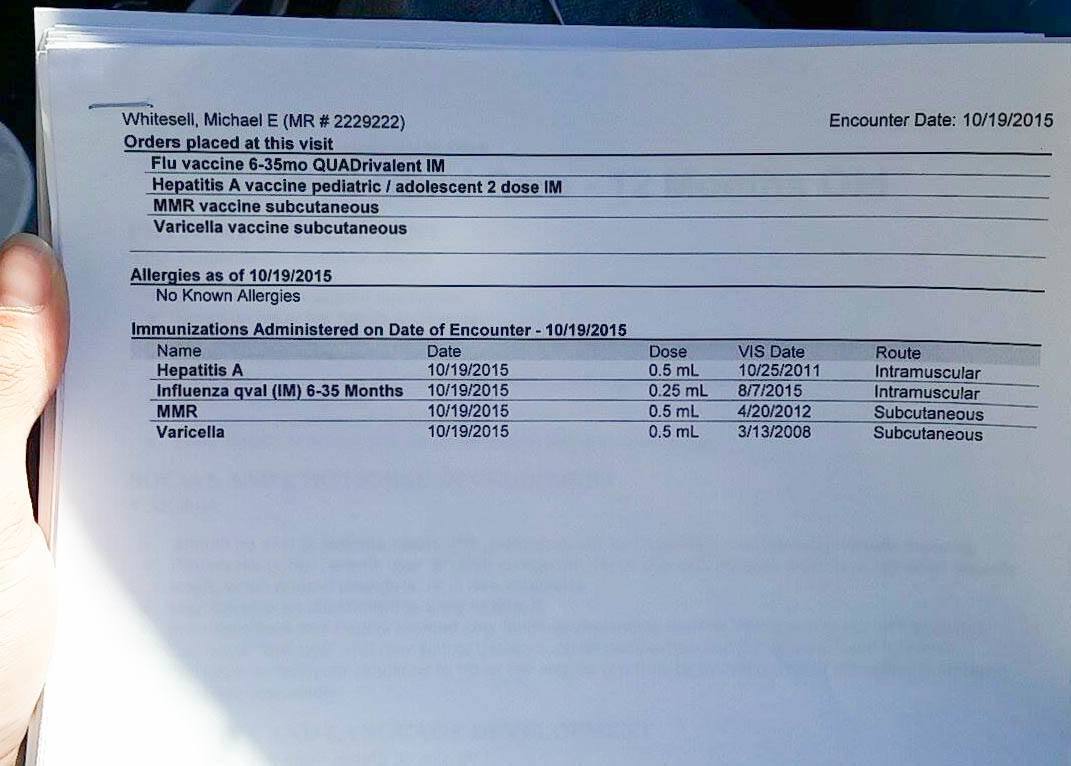
At the age of one, on October 19, 2015, he was taken in for his one year well-child visit. He received the MMR, varicella, hepatitis A, and flu shot vaccines. This is six vaccine doses.
Three days after this well visit, Michael had a slight fever. His pediatrician suggested to his parents that they give him some medication to reduce the fever. His parents gave Michael some Tylenol and his fever went down.
Michael seemed normal and was back to his old self. He was eating well and appeared to be fine. He even went to bed at the usual time and fell asleep in his crib.
Early the next day, just after seven o’clock in the morning, his mother, Brittney, found him lying on his stomach, cold, lifeless, and blue.

 She called 911.
While on the phone, Michael’s dad, Thomas, performed CPR on him. Both parents were in so much shock and just wanted him to come back to life, but he was already gone. Nothing they could do would bring him back.
Michael passed away on October 23, 2015, less than four days after he was vaccinated and given Tylenol.
Michael was found lying on his stomach but did not die from suffocation; the coroner already ruled this out. An autopsy was performed on Michael, but the results will not be given to his family for another two months or longer.
This is a copy of Michael’s recent vaccine record.

Michael’s Parents Were Investigated And His Older Brother Was Removed By CPS

Both Michael and Keegan were being raised by their Aunt Brittney and Uncle Thomas Whitesell since birth. Their biological mother, Thomas’s sister, lives with some medical issues associated with epilepsy and the children’s biological fathers haven’t really been around to take on the parenting role, so the boy’s mother entrusted her brother Thomas and his wife to raise these children.

 Everyone was loved and happy and the children’s birth mother has always been in their life.
After years of trying to have children of their own without success, Brittney and Thomas felt blessed to provide a loving home for their nephews. They enjoyed being parents and loved raising Michael and Keegan.
When it came time to take the children in for their well child visits, Brittney and Thomas trusted the doctors with their children’s lives. They had their children vaccinated because they were just doing what the doctor recommended.
They didn’t know how harmful vaccines could be, until it was too late.
After Michael died, a routine investigation was done by Indiana’s Child Protective Services (CPS) and Michael’s older brother Keegan was removed from their home, in part because Brittney and Thomas are the children’s aunt and uncle, not their biological parents.
Keegan is only three years old and is now living with Brittney’s grandmother. Thomas and Brittney have been told Keegan will remain there at least until the autopsy report comes back.
Being investigated after a baby dies at home, after vaccination, is what grieving parents are put through. Investigators are sometimes looking to blame the parents, instead of the vaccines.

 In this situation, it is hard to think CPS has a child’s best interest in mind when they know Keegan just lost his little brother and now they’ve taken him away from the only parents he knows.
Michael and his older brother Keegan were always with each other playing and they loved each other very much. Keegan needs his parents, to help him grieve. Telling him he can’t stay with those he knows as his mom and dad does not seem to be in the best interest of Keegan.
After having to accept Michael had passed away, and then to have Keegan taken away, Thomas wrote,

“It sucks not being able to grieve with our three year old boy ourselves, they treat us as criminals when we did nothing wrong.”
Material organized by Olais K. Raphael | olais@olais.co.tz | www.olais.co.tz 
Social Worker | Community Organizer | NGO Founder | Public Speaker | Environmental Advocacy | Youth Worker | Social Leader | Life/Author Coach | Author of Is Like a Dream Novel and Sauti ya Mtoto Aliyepotea | Social Activist | Social Educator | Professional Photographer | Movie Editor 
Source: http://www.drbuttar.com/category/vaccines-2/ 

Thursday, April 14, 2016

Victims of HPV Vaccine in Japan Will Sue State and Vaccine Makers

In the U.S., the human papillomavirus (HPV) vaccine has been a subject of controversy from the very beginning after Merck’s Gardasil vaccine was licensed in 2006.1 Japan is one of the many nations raising concerns about HPV vaccine following persistent reports that girls are suffering severe adverse effects after getting vaccinated.2

Controversy Surrounding Safety of HPV Vaccine in Japan

Here is what happened in Japan in a nutshell. In December 2010, the HPV vaccine  (both Merck’s Gardasil and Cervarix manufactured by GlaxoSmithKline) was provided at no cost to Japanese girls between the ages of 12-16 years old. In April 2013, the vaccine was officially included in Japan’s national immunization program. However, two months later, Japan’s Ministry of Health, Labor and Welfare publically announced that it had decided to withdraw its HPV vaccine recommendation.3 The decision was in response to numerous reports that formerly healthy vaccine recipients were experiencing alarming side effects ranging from short-term memory loss to paralysis.4 In October 2013, a special taskforce was formed to investigate the side effects of the HPV vaccine.5
Interestingly, HPV vaccines were not withdrawn from the market in Japan and continued to be available, but local governments, as advised by Japan’s Ministry of Health, Labor and Welfare, did not actively promote its use. Girls can still receive the vaccine if they chose to do so but doctors and other vaccine providers must inform them that the health ministry does not recommend it.6 
The Nationwide Liaison Association of Cervical Cancer Vaccine Victims and Parents in Japan and Dr. Sotaro Sato, director of the Sato Cardiovascular Internal Medicine Hospital in Osaki speculate that the motive behind this decision is more than likely due to: 
fear of potential lawsuits being filed by the association on behalf of numerous desperate families whose beloved, previously healthy daughters have been seriously impaired, paralyzed or horribly devastated by HPV vaccinations. Japanese courts would be likely to find health bureaucrats responsible for the serious adverse effects inflicted on the girls if they did not take precautionary measures beforehand and leave some evidence that could later be used to prove they had at least tried to do something to block the further spread of health impairments to upcoming generations of teenage girls. This would be a particular problem if the government moves to reinstate their recommendation of these vaccines during the current fiscal year ending on 31 March 2014, due to pressure from politicians and academics with financial ties or other links to the vaccine manufacturers, lobbying activities, and consulting ‘experts’ hired by the manufacturers.7
Almost three years later, The Japan Times recently reported that a class action lawsuit will be filed after June 2016 against the Japanese government, Merck and GlaxoSmithKline by victims who have suffered severe side effects as a result of receiving the former government recommended vaccine. Twelve plaintiffs will file the lawsuit at four district courts in Tokyo, Nagoya, Osaka and Fukuoka.
The plaintiffs are demanding answers as to why they were not informed of the risks of HPV vaccine prior to receiving it.8  The defense team will be hosting seminars in the next two months in hopes of seeking additional plaintiffs.8 

Vaccine-Injured Victims Cannot Sue Vaccine Makers in the U.S

Unlike in Japan where vaccine-injured victims can directly file a lawsuit against the state and the vaccine manufacturers, the judicial process in the U.S. for vaccine-injured victims of HPV and other government recommended or mandated vaccines is remarkably different, to say the least.
Under current U.S. federal law, no one can directly sue a vaccine manufacturer in civil court after a vaccine causes the injury or death of a minor child or adult.9 To understand how this came about, it is important to understand the historical context of this issue.
Back in the early 1980s, parents were filing lawsuits on behalf of their minor children who were damaged or died from reactions to the diphtheria-tetanus-pertussis (DPT) vaccine and the live polio vaccine.
It was during this period when pharmaceutical companies demanded that Congress pass a law protecting them from all product liability from vaccine injuries and deaths by establishing a federal Vaccine Injury Compensation Program (VICP) to compensate vaccine-injured children.11  But with strong opposition from co-founders of  the National Vaccine Information Center (NVIC) and other consumers, the 1986 National Childhood Vaccine Injury Act preserved product liability if compensation was denied or there was evidence the drug company could have made a vaccine safer.10 
NVIC co-founder and president, Barbara Loe Fisher, said:
Parents successfully argued that, if Congress was going to give drug companies partial liability protection through the creation of a federal vaccine injury compensation alternative to a lawsuit, then language had to be written into the National Childhood Vaccine Injury Act of 1986 that protected a citizen’s right to sue drug companies when federal compensation was denied, or the company had the technological ability to make a vaccine less toxic but refused to do it. Continued civil liability was the safety net for American consumers in that law. Continued civil liability was the leverage that gave some financial incentive for drug companies to make vaccines safer and gave some political incentive for government officials to award federal compensation to the vaccine injured.”10 
Fast-forward to 2011,  in a split decision with Justices Ruth Bader Ginsberg and Sonia Sotomayor dissenting, the U.S. Supreme Court gave complete product liability protection to vaccine manufacturers and banned lawsuits against pharmaceutical companies for injuries and deaths caused by FDA licensed vaccines, even in cases of design defect. The ruling was in response to a 2005 lawsuit filed against Wyeth Inc. (now Pfizer, Inc.) and brought to the high court by the parents of Hannah Bruesewitz, who suffered encephalopathy and a residual seizure disorder after being given a third DPT shot in 1992.
Initial claims brought forth by Bruesewitz’s parents under the national VICP in 1995 were rejected driving them to file a civil court lawsuit against Wyeth, Inc. based on design defect.13 According to American Medical News, the U.S. Supreme Court stated:
The act reflects a sensible choice to leave complex epidemiological judgments about vaccine design to the [Food and Drug Administration] and the National Vaccine Program, rather than juries.12 
So, now, unlike the original National Childhood Vaccine Injury Act of 1986 that gave plaintiffs the option to sue drug companies when denied federal compensation, today Americans are restricted from suing vaccine manufacturers and instead are required to sue the Secretary of DHHS by filing a vaccine injury claim through the VICP.12
The 2011 Supreme Court ruling was a corporate bailout of vaccine manufacturers that excused the industry from any sort of accountability, leaving them with no incentive to make vaccines safer.10 The increasing number of states mandating more vaccines and restricting or removing vaccine exemptions, together with the failures of the VICP and Pharma’s total liability shield, is leading to more widespread questioning of U.S. vaccine policies and laws.  
The fact that vaccine victims in Japan (and other countries) have the legal right to hold pharmaceutical companies liable for the safety of their products in civil court and vaccine victims in the U.S. do not, is adding more fuel to the debate about vaccine safety and choice

Source: http://www.thevaccinereaction.org/2016/04/victims-of-hpv-vaccine-in-japan-will-sue-state-and-vaccine-makers/ 

Bang: Robert De Niro wakes up and opens up on vaccines


Bang: Robert De Niro wakes up and opens up on vaccines
After censoring the film Vaxxed, he decides to make a stand
And…
Media won’t reveal medically-caused death numbers
by Jon Rappoport
April 13, 2016
(To read about Jon’s mega-collection, The Matrix Revealedclick here.)
On NBC’s Today Show, Robert De Niro just broke his trance and started talking sense about vaccines. He refused to back down and knuckle under. Watch the interview here.
It’s the leading edge of a new storm.
De Niro wouldn’t accept the canned notion that vaccines are remarkably safe and effective and necessary. He expressed doubts. He linked vaccines to autism. He stood with the mothers who know their children were tragically damaged after being vaccinated.
You could say this is too little too late, because the actor already canceled Vaxxed (trailer) at Tribeca, his film festival, but it isn’t too late. Vaxxed is playing in New York at the Angelika Theater (through April 21). It’s going to travel. The demand for it is great.
Again, watch De Niro’s interview.
So let me now broach the wider subject of medically caused death and damage, because the background is essential to understanding the medical edifice, and why the media, at the deepest level, must remain silent.
“If instead of drugs like warfarin, dabigatran, levofloxacin, carboplatin, and lisinopril (the five leading killers in the FDA database), the massive numbers of deaths per year were led by gingko, ginseng, vitamin D, niacin, and raw milk, what do you think would happen?
“I’ll tell you what would happen. SEALS, Delta Force, SWAT teams, snipers, predator drones, tanks, and infantry would be attacking every health-food store in America. The resulting fatalities would be written off as necessary collateral damage in the fight to keep America safe and healthy.” (Why the FDA should be charged with murder, Jon Rappoport)
I know major media won’t reveal medically-caused death numbers, because I’ve published reports for years, and I’ve contacted news people with the facts; and nothing happens.
So we begin with a few citations.
July 26, 2000, Journal of the American Medical Association; author, Dr. Barbara Starfield, revered public health expert at the Johns Hopkins School of Public Health; “Is US health really the best in the world?”
Starfield reported that the US medical system kills 225,000 Americans a year. 106,000 as a result of FDA-approved medical drugs, and 119,000 as a result of mistreatment and errors in hospitals. Extrapolate the numbers to a decade: that’s 2.25 million deaths. You might want to read that last number again.
I interviewed Starfield in 2009. I asked her whether she was aware of any overall effort by the US government to eliminate this holocaust, and whether she had ever been contacted by any government agency to consult on such an effort. She answered a resounding no to both questions.
Here is another citation: BMJ June 7, 2012 (BMJ 2012:344:e3989). Author, Jeanne Lenzer. Lenzer refers to a report by the Institute for Safe Medication Practices: “It calculated that in 2011 prescription drugs were associated with two to four million people in the US experiencing ‘serious, disabling, or fatal injuries, including 128,000 deaths.’”
The report called this “one of the most significant perils to humans resulting from human activity.”
The report was compiled by outside researchers who went into the FDA’s own database of “serious adverse [medical-drug] events.”
Therefore, to say the FDA isn’t aware of this finding would be absurd. The FDA knows. The FDA knows and it isn’t saying anything about it, because the FDA certifies, as safe and effective, all the medical drugs that are routinely maiming and killing Americans.
Previously, I have documented that the FDA knows; because the FDA had, until recently, a page on its own website that admits 100,000 people are killed every year by medical drugs, and two million more people are severely injured by the drugs. A few months ago, the page was removed.
Why won’t major media report these facts?
The obvious reason: their big-spending pharmaceutical advertisers would drop them like hot potatoes.
But there are other reasons.
Every medical bureaucrat or medical shill or medical expert who jumps aboard the media train, to assure the public that drugs and vaccines are remarkably safe, is sitting on the time bomb I have described above.
This is a key, key fact. If this bomb were widely recognized, who would continue to believe these professional liars? Who would accept anything they say? How could they possibly sustain their credibility?
“Well, the system I represent kills 2.25 million people per decade, and maims between 20 and 40 million more people per decade, but I want to assure you this vaccine presents no problems at all. It’s incredibly safe.”
It would be on the order of Joseph Stalin, who sent 20-40 million people to their deaths, stating that hard work in harsh conditions improved general health.
Every single pronouncement, on any subject, issued via the medical cartel’s Ministry of Truth would fall on disbelieving ears, and only increase general outrage.
The assuring attitudes of its professional representatives would immediately be taken as rank fraud of the worst kind.
And this would just be the beginning of the trouble.
Mainstream reporters and editors and publishers are well aware that telling the truth and continuing to pound on it would do great damage to the whole medical system. The fact that the damage is deserved is beside the point. Undermining a basic institution of society is not on the media’s calendar.
The media are there to give credibility to society and its structures. That’s why they’re called “major” instead of “minor.”
When hard rains fall, the media are there with an umbrella to hold over organized society’s head. To walk away in the middle of a downpour would leave the status quo unprotected.
“Defending the Crown” is another way to put it. The King may make mistakes, he may commit heinous offenses, but he is the King, and therefore his position must remain secure.
Young journalists learn this point quickly. If in their zeal, they cross the threshold and attempt to expose a central myth, fairy tale, legend, they’re put back in their place. They absorb the message. Journalism has limits. Certain truths are silent truths.
Over the years, I’ve talked to reporters who are solidly addicted to obfuscations. Like any addict, they have an army of excuses to rationalize their behavior. They’re all attitude. They snarl and grouse if you push them too far. They assert their position, as if they own their territory, as if they’ve earned their titles.
They remind me of drunks with significant bank accounts. They’re not winos drifting in alleys. Oh no. They imbibe the good stuff. They take pride in that.
The medical experts are worse. Their pretense of idealism knows no limits, and is matched only by their claim to bullet-proof knowledge. They resemble elite new anchors, who above all learn superior acting skills. The central mission of both professionals: sound and appear utterly convincing.
What would you do if you were an actor working in a major Broadway production, along with several actors who were, in real life, murderers? Every night you go out on the boards and do your turns, and you know the play is, in a real sense, a cover for the terrible deeds your partners are committing.
I can tell you what news anchors and reporters do in that situation. They polish their performance, hoping to establish such a high degree of credibility that the secrets they conceal will never be suspected, or God forbid, exposed.
When you peel the veneer away, they are enablers, persons of interest, co-conspirators.

Visit the link https://jonrappoport.wordpress.com/2016/04/13/bang-robert-de-niro-wakes-up-and-opens-up-on-vaccines/ 

Tuesday, November 18, 2014

Footballers Ronaldo and Bale in Ebola awareness campaign

Footballers Cristiano Ronaldo, Didier Drogba and Gareth Bale have all appeared in a new Ebola awareness campaign run by Fifa.
The players from some of Europe's biggest clubs came together for the "11 Against Ebola" video.
It promotes simple health messages selected with the help of doctors and health experts in West Africa.

Source; BBC World News

Wednesday, August 6, 2014

6 Things You Didn't Know About Watermelon

6 Things You Didn't Know About Watermelon


By Dr. Mercola


In the US, July is National Watermelon Month, so named not only because a cool, refreshing slice of watermelon represents the epitome of summer, but also because watermelon harvests peak this month.1
Watermelon is now the most-consumed melon in the US (followed by cantaloupe and honeydew). This cousin to cucumbers, pumpkins, and squash is thought to have originated in Egypt close to 5,000 years ago, where it is depicted in hieroglyphics.
Today, upwards of 300 watermelon varieties are grown in the US and Mexico (although only about 50 are popular).2 You may think you know everything there is to know about this summertime fruit, but allow me to surprise you… watermelon is more than just delicious… it’s a super-healthy addition to your diet (in moderation, of course).
You just need to be careful when eating any melon, including watermelon to follow the advice of Wayne Pickering in my interview. Eat melon alone or leave it alone because it will make your stomach groan. So ideally, no food 30 minutes before or after eating melons.

6 Watermelon Facts That Might Surprise You

1. Watermelon Has More Lycopene Than Raw Tomatoes
Lycopene is a powerful carotenoid antioxidant that gives fruits and vegetables a pink or red color. It’s most often associated with tomatoes, but watermelon is actually a more concentrated source.
Compared to a large fresh tomato, one cup of watermelon has 1.5 times the lycopene (6 milligrams (mg) in watermelon compared to 4 mg in a tomato).3 More on why lycopene is so important shortly…
2. Watermelon Juice May Relieve Muscle Soreness
If you have a juicer, try juicing about one-third of a fresh watermelon and drinking its juice prior to your next workout. This contains a little over one gram of l-citrulline, an amino acid that seems to protect against muscle pain.
One study found that men who drank natural unpasteurized watermelon juice prior to their workouts had reduced muscle soreness 24 hours later compared to those who drank a placebo.4
You do need to be careful with drinking watermelon juice, though, as it contains a significant amount of fructose. It may be better to eat the entire fruit, or opt for these other tips to prevent muscle soreness.
3. Watermelon Is a Fruit and a Vegetable
Remember how watermelon is related to cucumbers, pumpkin, and squash? That’s because it’s part vegetable and part fruit (it’s a sweet, seed-producing plant, after all).5 The other clue that watermelon is both fruit and vegetable? The rind is entirely edible…
4. You Can Eat Watermelon Rind and Seeds
Most people throw away the watermelon rind, but try putting it in a blender with some lime for a healthy, refreshing treat.6 Not only does the rind contain plenty of health-promoting and blood-building chlorophyll, but the rind actually contains more of the amino acid citrulline than the pink flesh.7 
Citrulline is converted to arginine in your kidneys, and not only is this amino acid important for heart health and maintaining your immune system, but it has been researched to have potential therapeutic value in over 100 health conditions.8
While many people prefer seedless watermelon varieties, black watermelon seeds are edible and actually quite healthy. They contain iron, zinc, protein, and fiber. (In case you were wondering, seedless watermelons aren’t genetically modified, as they’re the result of hybridization.9)
5. It’s Mostly Water
This might not be surprising, but it’s still a fun fact; watermelon is more than 91 percent water.10 This means that eating watermelon with you on a hot summer day is a tasty way to help you stay hydrated and avoid dehydration (it’s not a substitute for drinking plenty of fresh water, however).
6. Some Watermelon Are Yellow
The Yellow Crimson watermelon has yellow flesh with a sweeter, honey flavor than the more popular pink-fleshed Crimson Sweet. It’s likely that yellow watermelon offers its own unique set of nutritional benefits, but most research to date has focused on the pink-fleshed varieties.11

Lycopene: Watermelon’s Nutritional Claim to Fame

Watermelon is an excellent source of lycopene, with upwards of 6,500 micrograms (6.5 mg) in less than half a cup (the red-fleshed varieties will contain significantly more lycopene than yellow-fleshed watermelon).
Also noteworthy, the lycopene in watermelon appears to be quite stable, with little deterioration occurring even after it’s been cut and stored in the refrigerator for more than two days. In one study, it took about seven days of storage for the lycopene to deteriorate, and then it was only by about 6 percent to 11 percent.12
So what makes lycopene so important? Lycopene's antioxidant activity has long been suggested to be more powerful than that of other carotenoids, such as beta-carotene. In one study, after controlling for other stroke risk factors, such as older age and diabetes, they found that men with the highest blood levels of lycopene were 55 percent less likely to have a stroke than those with the lowest.13
A 2014 meta-analysis also revealed that lycopene decreased stroke risk (including stroke occurrence or mortality) by more than 19 percent.14 In addition to lowering your risk of stroke, lycopene has been shown to have potential anti-cancer activity, likely due to its potent antioxidant properties.
A 2014 meta-analysis of 10 studies also showed that dietary lycopene may protect against the risk of ovarian cancer among postmenopausal women.15There is also some evidence from animal studies that lycopene may help with cancer treatment as well.
One study found that lycopene treatment reduced the growth of brain tumors while another showed frequent lycopene intake suppressed breast tumor growth in mice.16

Watermelon Extract May Significantly Reduce Blood Pressure

New research also highlights the role of watermelon nutrients on heart attack prevention, via a significant reduction in blood pressure. Obese study participants who received citrulline and arginine supplements derived from watermelon extract had significant improvements in blood pressure and cardiac stress, both while at rest and undergoing a stressful cold-water test.17 According to the researchers:
“Watermelon supplementation reduced aortic BP [blood pressure] and myocardial oxygen demand during CPT [cold pressor test] and the magnitude of the cold-induced increase in wave reflection in obese adults with hypertension. Watermelon may provide cardioprotection by attenuating cold-induced aortic hemodynamic responses.”
Remember, in your body the citrulline in watermelon is converted into L-arginine, which is a precursor to nitric oxide. Adequate nitric oxide is required to enable you blood vessels to stay relaxed and open for blood flow, which is one reason why it may help lower blood pressure.

Watermelon for Inflammation, Sexual Health, and More

L-arginine may also help with erectile dysfunction by helping to relax your blood vessels, including those supplying blood to your penis – and that’s why watermelon is sometimes referred to as “Nature’s Viagra.” In fact, citrulline supplementation has been found to improve erection hardness in men with mild erectile dysfunction.18
What else is watermelon good for? It’s rich in anti-inflammatory substances. For instance, watermelon contains the anti-inflammatory antioxidant lycopene as well as cucurbitacin E, or tripterpenoid, which reduces the activity of the pain and inflammation-causing enzyme cyclooxygenase – the same enzyme blocked by COX-2 inhibitors, which include most NSAIDs like aspirin and ibuprofen. While being very low in calories (about 46 calories in a cup), watermelon also contains an impressive variety of other important nutrients in which many Americans are lacking, including:
  • Vitamin C
  • Vitamin B6
  • Potassium
  • Vitamin A
  • Magnesium

How to Pick the Perfect Watermelon


Cutting into a watermelon and finding out it lacks flavor is disappointing. There’s a trick you can use to pick out a ripe watermelon, either from your farmer’s market or your own melon patch. Look for a pale, buttery-yellow spot (not white or green) on the bottom. This is where the watermelon sits on the ground ripening, and it’s one of the best indicators of ripeness you can use (even commercial watermelon pickers use this as a gauge). Other tricks for picking a ripe watermelon include:
  • Should be heavy for its size
  • Smooth rind with a dull top (the top is the side opposite the ground spot)
  • The thump test (this is controversial, but ripe watermelon is said to have a hollow bass sound)
Store your watermelon in a cool area (50-60 degrees F) until it’s cut. Cut watermelon should be refrigerated (and be sure to wipe off your watermelon with a damp cloth prior to cutting it). Remember, try the rind blended with some lime juice rather than simply tossing it in the trash (choose an organic watermelon especially if you’ll be eating the rind). Finally, watermelon should be enjoyed in moderation due to its fructose content. One-sixteenth of a medium watermelon contains 11.3 grams of fructose (I recommend keeping your total fructose intake below 25 grams of fructose per day if you're in good health, and below 15 grams a day if you’re overweight or have high blood pressure or diabetes).